
Is it time HR got over its inferiority complex?
Maybe (she said squirming).
Before we rush to "just be more confident", let's reflect on why this is even an issue for us as a profession.
We didn't start with the weight of centuries of professional credibility like law or the precision mystique of finance. Typically, we grew from being the CEO's secretary tracking holidays, employment agreements, and personnel files. That origin hasn’t positioned us as instant peers to the CFO or Chief Legal. Over decades (not centuries), we've layered on recruitment, employment relations, learning and development, remuneration, performance management, organisational development and design, culture, wellbeing, and workforce strategy. We've professionalised deeply. Yet the old perceptions linger and gender is right at its heart.
Gender and HR
Here in New Zealand, HRNZ data shows our profession is 82% female. Here's how female representation stacks up across these three professions.
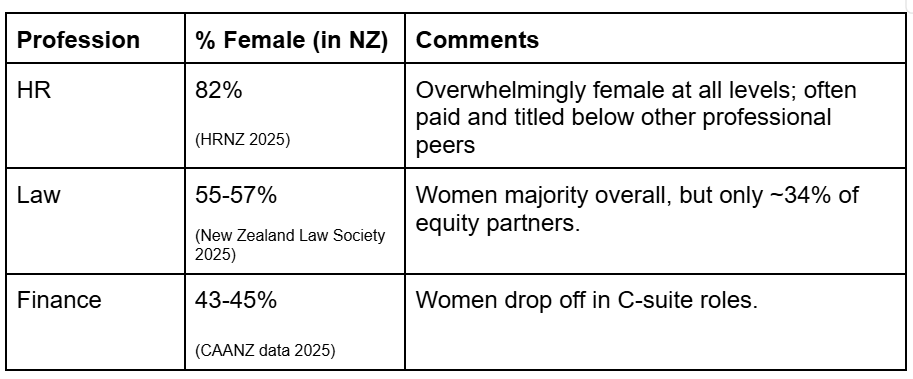
Does this explain why HR feels sidelined? We're not just majority-female; we're near-totally so, without law or finance's "serious" heritage to buffer us. Even in those other professions, women hit glass ceilings at power and pay peaks. In HR, the feminisation runs deeper within systems that still pay men more.
The weight of "HR ladies"
I hear it from brilliant senior HR leaders: "I give my view, but they won't necessarily listen." It's said with quiet resignation, in confidence to another HR professional who has been there herself, as if optional is our natural place.
I remember a senior operations leader once saying to me and my team (which included three men) "thank you to the HR ladies". So much is wrong with that, but at the time, it came and went with misplaced smiles and grace. "Legal ladies" or "finance girls" isn’t something I’ve ever heard, and thank goodness for that. I’m not advocating a race to the bottom of the misogyny bin. Law and finance read as male or neutral and authoritative. HR gets softened, maternalised, even as we power the workforce that makes everything else possible.
This isn't HR’s personal weakness. Is there an element of internalised misogyny in a profession born "feminine"? Perhaps. Uncomfortable as that is to write, I feel a ring of possible truth. We see our insights as debatable and malleable which undervalues our contribution compared to a "hard" response from our finance or legal peers.
Our heritage and its hidden gift
Law boasts centuries of history. Finance traces a story from a fifteenth century friar to modern global markets. Their histories carry weight and status.
HR? A few decades away from "personnel files and holidays" overload. No grand founding of pay and power. We arrive at board tables feeling like newcomers.
Could our youth free us? We're not precedent-bound. We shape workforce risk and mitigation, remuneration, culture and workforce design. Crucial, strategic enablers in a fast and fluid world. Board directors I talk to happily admit that HR expertise is what they need more of, not less, in their discussions and decisions in strategy and risk.
What and how we get over our inferiority
This is personal. I am of the HR profession, not observing it from a distance. I am writing this as much for myself as for you, so let’s go into this with compassion and power for ourselves and each other.
Acknowledge the context
HR is a highly feminised profession operating in a labour market that still pays women less overall. Other professions seen as masculine or neutral, such as law and finance, also have issues and carry their own gender gaps.
Recognise that our caution is understandable
If you've been patronised, sidelined or framed as "the HR ladies", you are not imagining it. Your hesitancy has a context and yet we don’t have to let it limit us, which brings me on to…
Demonstrate our professional power
What if we see our caution but choose to do it anyway? In service of driving our professional value and contribution. Offer what is uniquely ours: evidence and insight into people, work, systems and culture. Connect our advice clearly to risk, value and outcomes, so it can sit alongside legal and financial advice as an equal part of the decision.
We can't rid ourselves of our inferiority complex overnight, with its ugly undertones of misogyny, but we can stop treating our own expertise as the "nice to have" after the "real work" is done.
It starts with us valuing our professionalism to offer it unapologetically. Not louder, but clearer, with conviction and connection to our colleagues across the C-suite. Our businesses, governments and economy are at their best when HR's voice sits peer-to-peer when the big and impactful decisions are made.